What Is Freeze-Drying and How Does It Work?
Freeze-drying, or sublimation drying, is a preservation method in which a product is first deep-frozen and then placed in a vacuum chamber. Under low pressure, frozen water transitions directly from a solid state into a gas, bypassing the liquid phase entirely. This physical process is known as sublimation.
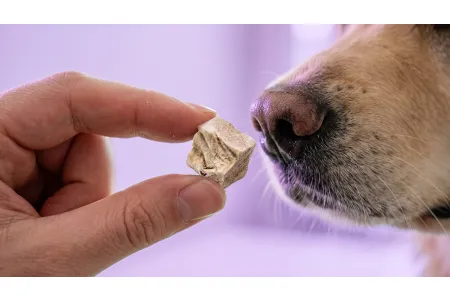
For treat manufacturing, this allows using high-quality meat, fish, or organ meats without adding glycerin, salt, sugar, or synthetic flavorings. Because the product is never boiled or baked, it retains the natural aroma and taste of fresh ingredients, making it highly palatable even to selective cats and dogs.
Benefits of Freeze-Dried Treats
-
Simple and Transparent Composition: Most freeze-dried treats consist of just one ingredient (such as turkey breast, heart, or salmon)—free from grains, starches, or artificial flavor enhancers.
-
High Palatability: Natural volatile aromatic compounds do not evaporate along with boiling water, as happens during thermal processing.
-
Convenience and Shelf Stability: Thanks to low residual moisture (typically 2–5%), these treats require no refrigeration, are lightweight, and offer a long shelf life in airtight packaging.
Freeze-Drying vs. Traditional Dehydration (Air-Drying)
Both methods remove moisture, yet they differ significantly in their technology and the final properties of the product:
| Criterion | Freeze-Drying (Lyophilization) | Air-Drying (Warm Air Dehydration) |
| Process Principle | Deep freezing + sublimation of ice under vacuum. | Prolonged evaporation of moisture using warm air (typically 50–75 °C / 122–167 °F). |
| Texture | Porous, light, and crunchy; breaks easily or crumbles into powder (ideal as a food topper). | Dense, fibrous, and chewy; requires longer mastication. |
| Nutrient Retention | Better preserved: the absence of high heat helps protect heat-sensitive vitamins and the natural protein structure [1, 2]. | Good: though prolonged exposure to heat and oxygen partially reduces B vitamins and oxidizes fats. |
| Rehydration | The porous structure absorbs water quickly, restoring a texture close to fresh meat. | Absorbs moisture slowly due to compacted fibers. |
Production Stages: What Happens to the Ingredients?
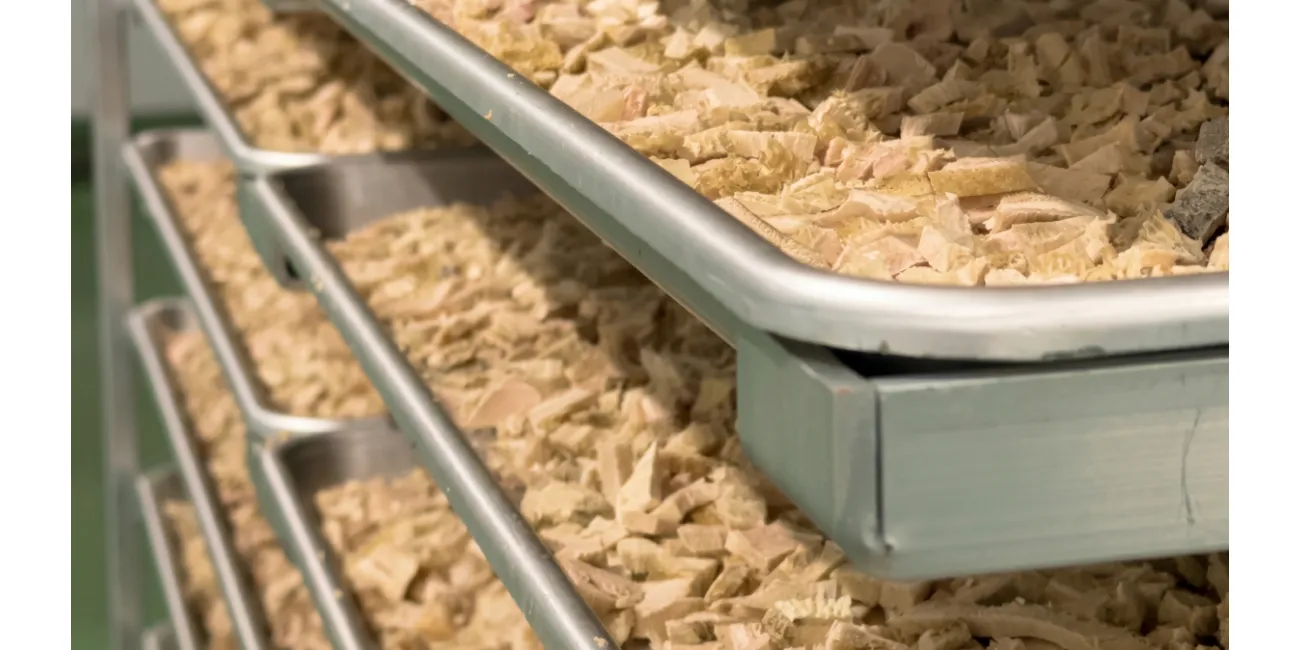
The technological cycle consists of three sequential phases:
-
Rapid Freezing. Raw ingredients are cooled to ultra-low temperatures (typically −30 °C to −50 °C / −22 °F to −58 °F). Fast freezing forms microscopic ice crystals that minimise damage to cell membranes, helping lock in the natural tissue structure.
-
Primary Drying (Sublimation). A deep vacuum is created in the chamber, and minimal heat is applied—just enough to convert ice directly into vapor. This stage removes approximately 90–95% of free moisture.
-
Secondary Drying (Desorption). The temperature is slightly raised (remaining well within safe limits to avoid thermal damage) to remove remaining bound water molecules.
Because water never enters a liquid state during drying, the product experiences minimal shrinkage, retaining its original volume and porous structure.
Moisture Control and Microbiological Safety: What FEDIAF Guidelines Recommend
Reducing moisture content to 2–5% (and water activity to $a_w < 0.6$) halts the growth and proliferation of bacteria, mold, and yeast without the need for chemical preservatives.
However, as noted in FEDIAF’s Guide to Good Practice for the Manufacture of Safe Pet Foods, freeze-drying alone is not a sterilization step. At sub-zero temperatures, pathogenic microorganisms (such as Salmonella or Listeria) are not destroyed; rather, they enter a dormant state. Responsible manufacturers therefore ensure product safety through a comprehensive approach:
-
Sourcing raw materials exclusively from veterinary-inspected sources.
-
Conducting regular laboratory microbiological testing in accordance with HACCP food safety plans prior to market release.
Why Freeze-Drying Preserves Nutritional Value
Traditional pet food and treat manufacturing methods (extrusion, retorting/canning, baking) rely on high temperatures (100–180 °C / 212–356 °F). Heat can alter the spatial structure of proteins, reduce the bioavailability of critical amino acids (particularly lysine and taurine), and degrade heat-sensitive B vitamins (such as thiamine) [1].
By avoiding high-temperature cooking, freeze-drying supports:
-
Preservation of Native Protein Structure: Amino acids remain closer to their natural structure and digestibility profile compared to high-heat processed foods [2].
-
Protection of Vitamins: Heat-sensitive B-complex and fat-soluble vitamins are better protected from thermal degradation.
-
High Nutrient Density: Removing 95–98% of water means that 100 g of finished treats represents the dry-matter equivalent of roughly 350–400 g of fresh lean meat or fish.
How to Feed Freeze-Dried Treats Properly
Under FEDIAF labeling guidelines, single-ingredient freeze-dried treats are categorized as complementary pet food. While they are a rich source of animal protein, they do not contain the full spectrum of vitamins and minerals (such as a balanced calcium-to-phosphorus ratio) required for a complete daily diet.
To ensure treats remain a healthy addition to your pet's routine, follow these basic feeding practices:
-
The 10% Rule: Treats should make up no more than 10% of your pet's daily caloric intake.
-
Fresh Water Access: Because the product contains almost no moisture, always provide unlimited access to clean drinking water.
-
Proper Storage: Reseal the zip-lock pouch tightly after each use to prevent the treats from absorbing ambient humidity, preserving both crunchiness and safety.
Freeze-drying represents the intersection of modern food engineering and respect for the natural dietary needs of carnivores. Produced in alignment with established food safety guidelines, freeze-dried treats offer a great choice for pet owners seeking clean labels, high nutrient density, and appealing flavor for their companions.
References:
-
Hendriks, W. H., Emmens, M. M., Trass, B., & Pluske, J. R. (1999). Heat processing changes the protein quality of canned cat foods as measured with a rat bioassay. Journal of Animal Science, 77(3), 669–676.
-
Kerr, K. R., Vester Boler, B. M., Morris, C. L., Liu, K. J., & Swanson, K. S. (2012). Apparent total tract energy and macronutrient digestibility and fecal fermentative end-product concentrations of domestic cats fed extruded, raw beef-based, and cooked beef-based diets. Journal of Animal Science, 90(2), 515–522.